EP 6 -The Deliverance of the Blind and Mute Man
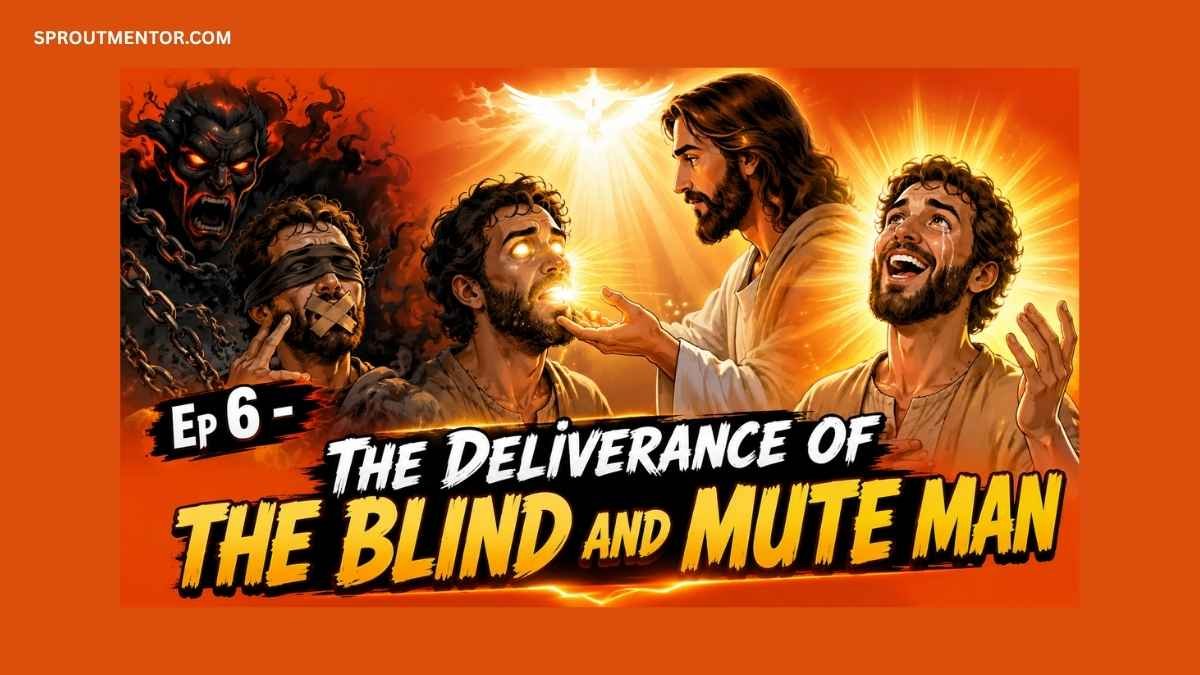
In this sixth case study, we now examine the deliverance of the blind and mute man found in Matthew 12:22-30 and Luke 11:14-26. This particular deliverance reveals deep truths about spiritual warfare, the Kingdom of God, Christ’s authority, and the importance of spiritual discernment. Before we examine the lessons, let us first read the account from the Gospel of Matthew.
“Then was brought unto him one possessed with a devil, blind, and dumb: and he healed him, insomuch that the blind and dumb both spake and saw.
And all the people were amazed, and said, Is not this the son of David?
But when the Pharisees heard it, they said, This fellow doth not cast out devils, but by Beelzebub the prince of the devils.
And Jesus knew their thoughts, and said unto them, Every kingdom divided against itself is brought to desolation and every city or house divided against itself shall not stand:
And if Satan cast out Satan, he is divided against himself how shall then his kingdom stand?
And if I by Beelzebub cast out devils, by whom do your children cast them out? therefore they shall be your judges.
But if I cast out devils by the Spirit of God, then the kingdom of God is come unto you.
Or else how can one enter into a strong man’s house, and spoil his goods, except he first bind the strong man? and then he will spoil his house.
He that is not with me is against me and he that gathereth not with me scattereth abroad.”
Matthew 12:22–30 KJV
Lesson One: Deliverance Is Multidimensional
“Then was brought unto him one possessed with a devil, blind, and dumb.” (Matthew 12:22) This man was not suffering in only one area of his life. The same spirit affected both his sight and his speech.
- The demon made the man mute. This shows us that demonic oppression can affect communication, testimony, worship, and prayer life. Many people struggle with a fear of speaking, an inability to pray, intimidation, confusion during prayer, or sudden speech problems. Satan often attacks the voice because voices carry authority, worship, prophecy, and testimony.
- The man was also blind. In Scripture, blindness can represent spiritual ignorance, deception, confusion, lack of discernment, and inability to perceive truth. Many people are not simply uninformed. They are spiritually blinded by the enemy. Deliverance can restore spiritual perception and understanding.
This teaches us that demonic oppression can manifest in multiple ways at the same time. A single spirit can create many symptoms in a person’s life. Why is this so? Because a spirit may enter in one way but manifest in different realms or modes of oppression.
This teaches deliverance ministers to understand the difference between entry points and manifestation points. Entry points are the doors through which spirits gain access into a person’s life, such as sin, the occult, etc. Manifestation points on the other side are the areas where the spirit chooses to express itself.
For example, a spirit may enter through trauma, abuse, occult involvement, addiction, or generational bondage, but later manifest through sickness, fear, lust, confusion, depression, or destructive habits.
This also teaches us to address the root and not merely the symptoms. Jesus did not simply heal blindness and muteness. He cast out the spirit causing the condition. Deliverance ministers must therefore discern whether a problem is physical, emotional, spiritual, or a combination of all three.
In addition, this emphasizes that discernment is essential because not every sickness is caused by demons, but some afflictions do have spiritual roots. For example, Jesus operated with wisdom and spiritual understanding, not emotionalism. Matthew 12:25 says: “And Jesus knew their thoughts.” Jesus functioned with spiritual revelation and discernment through the Holy Spirit. First John 2:20 says: “But ye have an unction from the Holy One, and ye know all things.”
Deliverance ministers must therefore grow in wisdom, sound doctrine, self-control, discernment, and biblical understanding. Luke 2:40 says Jesus was filled with wisdom, and Daniel also operated with wisdom and spiritual understanding in Babylon, as seen in Daniel 5:11-12. Power without wisdom creates confusion and error.
Application to Real Life: As believers, we must learn to look beyond surface symptoms. Sometimes repeated struggles may have deeper spiritual roots that require prayer, repentance, healing, discipleship, and deliverance. We must ask God for discernment and wisdom rather than making careless assumptions.
Lesson Two: Deliverance Is a Warfare of Kingdoms
“Every kingdom divided against itself is brought to desolation.” (Matthew 12:25). Jesus explained this deliverance using kingdom language because deliverance is not merely emotional therapy or human counselling, it is confrontation between two kingdoms: The Kingdom of God versus the kingdom of darkness.
When Jesus cast out the demon, He demonstrated that Heaven’s government is superior to Satan’s kingdom. This is so because deliverance involves binding strongholds and recovering territory. Jesus said in Matthew 12:29: “How can one enter into a strong man’s house, and spoil his goods, except he first bind the strong man?” There are ruling powers behind repeated cycles of bondage. These may include addiction, lust, witchcraft, fear, generational oppression, and destructive patterns.
Deliverance is not entertainment. It is kingdom advancement. Jesus also declared: “If I cast out devils by the Spirit of God, then the kingdom of God is come unto you.” (Matthew 12:28). Deliverance is proof that the Kingdom of God has arrived. When demons bow, Heaven is announcing dominion.
Application to Real Life: Believers must understand that victory does not come through human intelligence alone, but it comes from representing a greater Kingdom. The Bible says believers are: “a royal priesthood” (1 Peter 2:9), an idea reinforced in Revelation 1:6, which says Christ: “hath made us kings and priests unto God.” Jacob was called a prince who had power with God and men in Genesis 32:28. David also functioned as a king-priest who worshipped before God while ruling with authority. Like David and Jacob, we must embrace our royal priesthood mandate and walk in it as ambassadors and witnesses of Christ (Acts 1:8).
Lesson Three: Deliverance Is Possible Because Christ Has Greater Authority
In Matthew 12:29, Jesus described Satan as a strong man, but then revealed that someone stronger had arrived. Satan may hold families, minds, addictions, territories, and destinies captive, but Jesus is stronger. Deliverance is possible because Christ has authority over every demon, altar, covenant, curse, and principality.
Deliverance reveals the Messiahship and kingship of Christ. After seeing the miracle, the people asked, “Is not this the son of David?” (Matthew 12:23). The title “Son of David” was a Messianic title. The deliverance revealed Jesus as the promised King and Deliverer. True deliverance glorifies Jesus and not the minister. The purpose of spiritual power is the revelation of Christ.
Jesus came to restore what the enemy destroyed. Jesus also described deliverance as plundering Satan’s kingdom. Every delivered life is recovered from darkness. Jesus is still restoring destinies, marriages, minds, children, worshippers, and families. John 10:10 says: “The thief cometh not, but for to steal, and to kill, and to destroy.” This means that deliverance is a ministry of recovery and restoration of that which the enemy has stolen, killed, and destroyed.
Application to Real Life: Believers should not live in fear of the devil. Christ is greater than every power of darkness. When we stand in Christ, we stand under a higher authority.
Lesson Four: Deliverance Requires the Power of the Holy Spirit
Jesus said, “If I cast out devils by the Spirit of God…” (Matthew 12:28). Luke’s account says: “by the finger of God.” (Luke 11:20). These two verses show that Jesus ministered through partnership with the Holy Spirit. Deliverance without intimacy with the Holy Spirit becomes mechanical, dangerous, and powerless. Techniques do not cast out demons. The Spirit of God does.
This story also reveals that some people will call the work of the Holy Spirit demonic because they cannot understand it. The Pharisees accused Jesus of operating by Beelzebub. Religious people often become the greatest critics of genuine moves of God. Deliverance ministers should therefore expect misunderstanding, accusation, slander, mockery, and false labels.
Application to Real Life: Believers must pursue intimacy with the Holy Spirit through prayer, holiness, worship, and the Word of God. Spiritual authority flows from relationship with God and not from religious performance.
Lesson Five: Satan’s Kingdom Is Organized
Jesus said, “If Satan cast out Satan, he is divided against himself.” (Matthew 12:26) This statement reveals that the kingdom of darkness operates with order, hierarchy, assignments, and coordination. Paul confirms this in Ephesians 6:12: “For we wrestle not against flesh and blood, but against principalities, against powers, against the rulers of the darkness of this world, against spiritual wickedness in high places.”
Jesus also spoke about serpents and scorpions in Luke 10:19: “I give unto you power to tread on serpents and scorpions.” Throughout Scripture, serpents are often connected with deception and witchcraft, while scorpions symbolize torment and demonic oppression. And this is proof of different powers that have various ranks, functions, and realms of operations.
Jesus also taught another principle: “Every kingdom divided against itself is brought to desolation.” Division destroys churches, marriages, ministries, families, and prayer groups. Satan uses division because divided people become spiritually weak. Unity releases spiritual strength. Psalm 133 teaches that the blessing and anointing of God flow where there is unity. Genesis 1 also shows that order comes before multiplication, fruitfulness, and dominion. Before God told man to be fruitful and multiply in Genesis 1:28, He first brought order to chaos, darkness, and emptiness.
Application to Real Life: Believers must guard unity in homes, churches, and relationships. Disorder, bitterness, strife, and confusion create opportunities for spiritual weakness.
Lesson Six: There Is No Neutral Ground in Spiritual Warfare
Jesus said, “He that is not with me is against me.” (Luke 11:23) There is no middle ground in spiritual warfare. Every person eventually aligns with either Christ or darkness. Jesus taught that no one can serve two masters. Matthew 6:24 says: “No man can serve two masters.” Revelation 3:16 warns against spiritual lukewarmness: “Because thou art lukewarm… I will spue thee out of my mouth.” First Corinthians 10:21 says: “Ye cannot drink the cup of the Lord, and the cup of devils.” God desires complete surrender for He is a jealous God (Exodus 20:5).
Life itself is spiritual. Romans 1:20 teaches that invisible spiritual realities influence the visible world. Genesis 2:4 also reveals the spiritual foundation behind physical creation. The same way a child in the womb is connected through the umbilical cord is the same way the physical realm is connected to the spiritual realm. This is why Jesus said: “Whatsoever ye shall bind on earth shall be bound in heaven” (Matthew 18:18).
Application to Real Life: Believers must fully commit themselves to Christ. Partial obedience and double-minded living create spiritual instability and vulnerability. Also, we must stop seeing life as purely natural. Many battles are spiritual in nature. Prayer, holiness, submission to God, and spiritual authority are necessary in overcoming recurring bondage and oppression.
Lesson Seven: Deliverance Must Be Maintained Through Post-Deliverance Discipline
In Luke 11:24-26, Jesus warned about the unclean spirit returning: “I will return unto my house whence I came out.” This reveals that demons seek re-entry when doors remain open. For this reason, freedom must be maintained through discipline and closing doors such as sin, occult involvement, pornography, rebellion, unforgiveness, and destructive relationships.
Jesus warned that the returning spirit may come back with seven more wicked spirits. This teaches us that deliverance without discipleship creates vulnerability. A delivered person must be filled with: The Holy Spirit, the Word of God, prayer, fellowship, and holiness.
An empty spiritual house becomes a target. Jesus said the house was “swept and garnished.” The house looked clean outwardly, but it remained empty inwardly. Behavior modification alone is not enough. People need transformation, renewed minds, spiritual filling, and Christ-centered living. This means that deliverance is the beginning of a new walk with God, not the end.
Application to Real Life: After seasons of breakthrough, believers must continue growing spiritually. Prayer, discipleship, obedience, and fellowship help maintain freedom and spiritual stability.
Conclusion:
The central message of this entire story is not the demon. The central message is Jesus Christ: His authority, His kingdom, His superiority over Satan, and His identity as Messiah. Healthy deliverance ministry always keeps Jesus at the center. The goal is not fascination with demons but exaltation of Christ. Thus, every true deliverance ministry must point people to Jesus Christ, the Stronger Man who still sets captives free today.

Continue Reading More On Spiritual Warfare In The Guides Below:
|