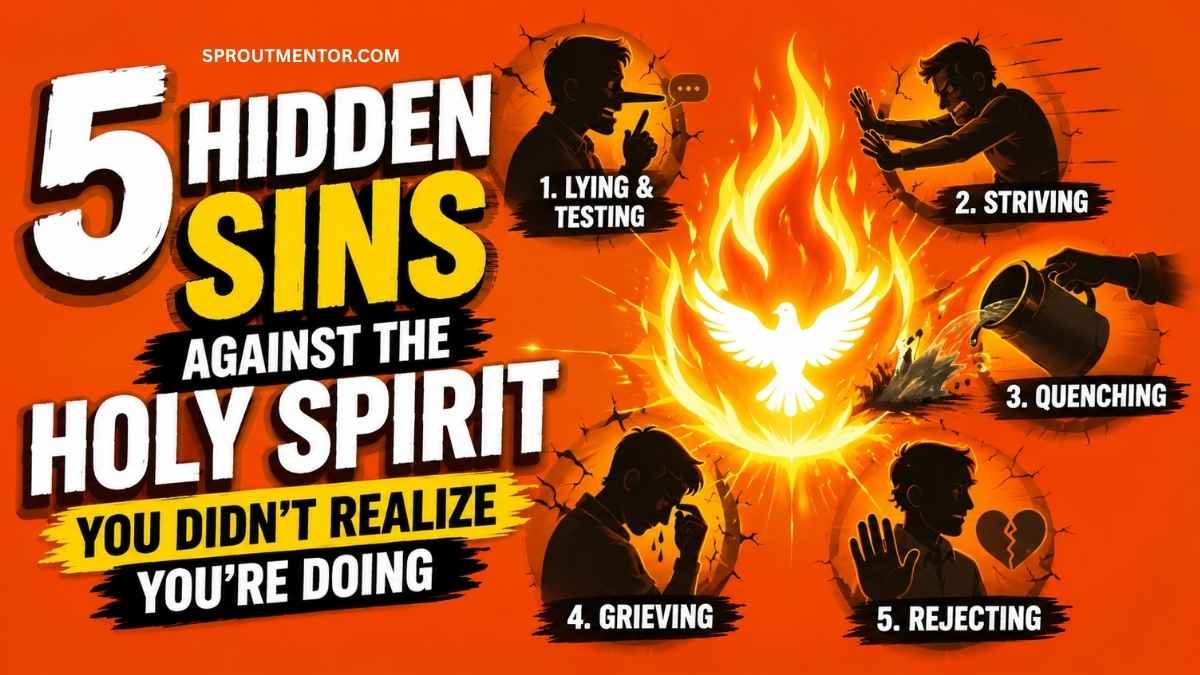
5 Hidden Sins Against the Holy Spirit You Didn’t Realize You’re Doing
The Holy Spirit is not only a presence to be experienced, He is also a Person who can be responded to, resisted, or received.
Throughout Scripture, we see moments where people do not just sin in general, but specifically sinned against the Holy Spirit by resisting His work, rejecting His voice, or disturbing His flow in their lives.
These are not just “bad habits.” They are spiritual attitudes that affect intimacy, sensitivity, and direction in God.
Let’s explore 5 hidden sins against the Holy Spirit in the Bible and how we can respond with repentance, awareness, and prayer.
1. Lying and Testing the Holy Spirit
“Ananias, why has Satan filled your heart to lie to the Holy Spirit…?”
(Acts 5:3)
In Acts 5, Ananias and Sapphira did not just lie to people—they lied within a spiritual system that was led by the Holy Spirit.
This reveals a deeper truth:
Whenever we manipulate truth in God’s work, we are not just deceiving people—we are resisting the Holy Spirit.
Testing the Spirit is when we treat God’s presence casually, as though He does not see the heart behind the action.
Prayer
“Holy Spirit, cleanse my heart from every form of deception. Remove from me the desire to appear right before people while being wrong before You. Teach me truth in the inward parts, and keep me honest before Your presence. Amen.”
2. Striving Against the Spirit
“My Spirit shall not strive with man forever…”
(Genesis 6:3)
Striving speaks of resistance—when the Spirit is pulling in one direction, but the heart is pulling in another.
In Genesis 6, humanity had drifted so far that the Spirit was being resisted continually.
Striving is not always loud rebellion—it can be subtle:
- resisting conviction
- ignoring correction
- delaying obedience
Over time, striving dulls sensitivity.
Prayer
“Holy Spirit, I surrender every area where I have resisted Your leading. Remove stubbornness from my heart. Make my spirit soft and responsive to Your voice. Lead me without resistance. Amen.”
3. Quenching the Holy Spirit
“Do not quench the Spirit.”
(1 Thessalonians 5:19)
Quenching is like pouring water on fire.
The Holy Spirit often moves with fire—conviction, boldness, worship, urgency—but we can suppress it.
We quench the Spirit when we:
- ignore promptings to pray
- suppress worship
- silence conviction
- prioritize comfort over obedience
A quenched spirit becomes spiritually cold without realizing it.
Prayer
“Holy Spirit, forgive me for every moment I have silenced Your fire in my life. Rekindle my passion for prayer, worship, and obedience. Let nothing in me suppress Your movement again. Amen.”
4. Grieving the Holy Spirit
“Do not grieve the Holy Spirit of God…”
(Ephesians 4:30)
Grieving speaks of relationship.
The Holy Spirit is not an impersonal force—He can be grieved by attitudes that break fellowship:
- bitterness
- unforgiveness
- corrupt speech
- repeated compromise
Grieving does not mean He abandons us—it means intimacy is affected.
Where quenching affects fire, grieving affects closeness.
Prayer
“Holy Spirit, heal every place in me that has caused You grief. Remove bitterness, pride, and impurity from my heart. Restore intimacy between us and teach me to walk in love and holiness. Amen.”
5. Rejecting the Holy Spirit
“You always resist the Holy Spirit…”
(Acts 7:51)
This is the most serious posture—consistent rejection of God’s voice.
Stephen spoke to people who repeatedly ignored God’s messengers and hardened their hearts.
Rejecting the Spirit is not always a single moment—it can be a pattern of refusing truth until the heart becomes closed.
When the Spirit is rejected long enough, spiritual blindness increases.
Prayer
“Holy Spirit, deliver me from every form of hardness in my heart. I never want to reject Your voice or resist Your truth. Keep me sensitive, humble, and quick to obey. Amen.”
Conclusion: A Call Back to Sensitivity
The goal of this message is not fear—it is awareness and restoration.
The Holy Spirit is not looking for perfect people.
He is looking for responsive hearts.
From Acts to Genesis, we see a consistent truth:
The health of our spiritual life depends on how we respond to the Holy Spirit.
Not just whether we believe in Him—but whether we listen, yield, and walk with Him daily.
May your life not only acknowledge the Holy Spirit—but honor Him.

Continue Reading More On Spiritual Warfare In The Guides Below:
|
Share This Blog Post On:














Short on time, but big on faith? We break down complex topics into easy-to-understand chunks, making the Bible accessible to everyone. Join us for answers to your Bible questions and encouragement for your daily walk with God. Click here to grow your faith, one byte at a time!